Learning materials · California codes · 2025 edition
Commissioning
Connect owner requirements, design, installation, testing, and operator training through CALGreen and California Energy Code requirements.
Past project experience
A completed commissioning project
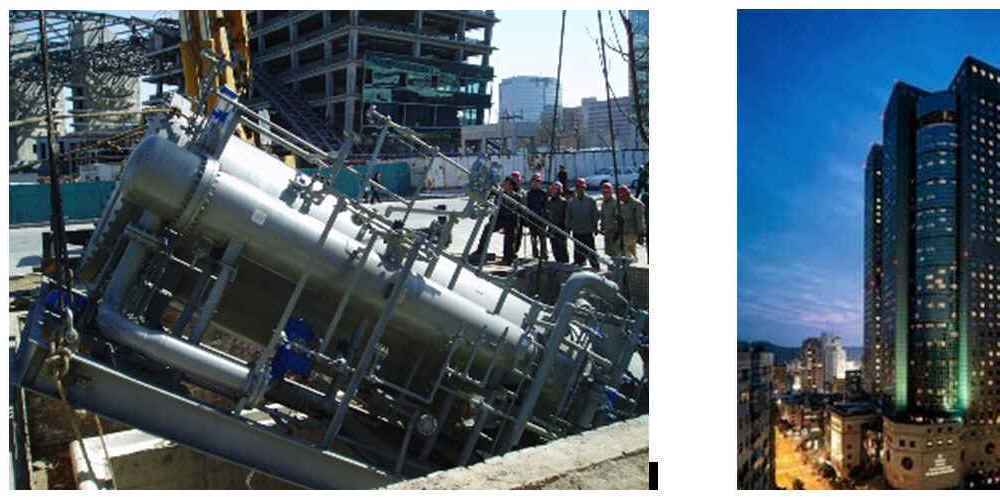
From our past commissioning work: project photographs showing mechanical equipment installation and the building.
Two parts of Title 24
The California Green Building Standards Code (CALGreen / CGBC) is Title 24, Part 11. The California Energy Code is Title 24, Part 6. Evaluate both scopes; their commissioning requirements overlap but are not interchangeable.
This lesson summarizes the 2025 editions, effective January 1, 2026. Confirm the permit application's applicable edition, occupancy, exceptions, and local amendments with the enforcing agency.
Title 24 · Part 11
CALGreen commissioning requirements
§5.410.2: Commissioning applies to covered new nonresidential buildings of 10,000 square feet or more. Include commissioning measures in the construction documents.
Exceptions include unconditioned warehouses, conditioned accessory areas under 10,000 square feet within those warehouses, and tenant improvements under 10,000 square feet described in §303.1.1. Review the exact project scope before applying an exception.
- §5.410.2.1 — Owner's Project Requirements (OPR)
- §5.410.2.2 — Basis of Design (BOD)
- §5.410.2.3 — Commissioning plan
- §5.410.2.4 — Functional performance testing
- §5.410.2.5 — Documentation and training, including systems manual and operation training
- §5.410.2.6 — Commissioning report
Smaller projects: §5.410.4 addresses testing and adjusting for new buildings under 10,000 square feet and new systems serving additions or alterations. Review its testing, balancing, reporting, and O&M requirements even when full commissioning is not triggered.
2025 CALGreen text reproduced in an official municipal checklist — §5.410 →
Title 24 · Part 6
Energy Code commissioning requirements
§120.8: For applicable newly constructed nonresidential buildings other than healthcare facilities, 10,000 square feet or more of conditioned space triggers the full commissioning requirements. Below that threshold, design review under §120.8(d) and associated construction-document measures under §120.8(e) still apply.
The commissioning scope covers applicable energy-regulated systems and components, excluding those related solely to covered processes. Do not substitute total warehouse area for conditioned area.
- §120.8(a) — Commissioning personnel
- §120.8(b) — Owner requirements
- §120.8(c) — Design basis
- §120.8(d) — Design-phase review
- §120.8(e) — Construction-document measures
- §120.8(f) — Commissioning plan
- §120.8(g) — Functional performance tests
- §120.8(h) — Systems documentation and training
- §120.8(i) — Final commissioning report
Acceptance testing remains a separate check
Coordinate commissioning with applicable mechanical acceptance testing (§120.5) and lighting-control acceptance testing (§130.4). A commissioning report does not replace required acceptance forms or qualified testing personnel. Check these obligations even on projects below the full-commissioning threshold.
Practical learning checklist
Plan the work from design to handover
- Record applicable codes, areas, systems, exceptions, and responsible parties.
- Prepare owner requirements and design basis where required; complete the design review.
- Put test scope, acceptance criteria, responsibilities, and schedule into project documents.
- Document installation checks, test results, deficiencies, corrections, and retesting.
- Deliver the systems manual, operator training records, and final report.
Use the current NRCC-CXR-E commissioning compliance form to organize Energy Code commitments. The form addresses functional testing, systems documentation, and staff training; supporting reports must demonstrate the completed work.